Restaurant technology adoption is the deliberate use of digital tools to improve how restaurants serve guests and run operations. The strongest adoption strategy prioritizes removing everyday friction—such as long waits, confusing ordering, payment delays, and inaccessible menus—before adding novelty features. That approach matters in an industry where the National Restaurant Association reported that 45% of restaurant operators said their business was not generating enough sales to be profitable in 2023, while consumers increasingly expect convenient digital service. The practical test is not whether a tool seems innovative, but whether it makes an important guest task easier, more reliable, or more inclusive. This article defines friction-first adoption, examines ordering, payment, and service technologies, and offers a framework for evaluating results without sacrificing hospitality.
Guest Friction Reduction as the Priority in Restaurant Technology Adoption
Guest friction reduction means identifying and removing obstacles that make it harder for people to discover, order, receive, pay for, or enjoy a restaurant’s offering. It is a prioritization principle, not a specific product category: a faster checkout, clearer allergen information, or a more dependable reservation system may qualify, while an attention-grabbing feature does not qualify unless it solves a real customer problem.
There is no single industry-standard definition of “guest friction reduction.” For this article, the term describes lowering the time, effort, uncertainty, or accessibility barriers a guest encounters across the service journey. The definition draws on service-design practice, which maps customer actions and pain points, and on restaurant-industry research about the role of technology in convenience and operations. The National Restaurant Association’s 2024 research found that 64% of adults said they would use technology to make ordering at a restaurant more convenient. That figure supports investment in useful digital options, but it does not mean every guest wants a fully automated experience.
The relevant hyponyms—the more specific forms of this broad principle—include ordering friction, payment friction, information and accessibility friction, and service-recovery friction. They are connected: a clear menu can prevent an order error; an accurate order can reduce staff rework; and a dependable payment flow can shorten the final step of a meal. The best technology portfolio therefore follows the whole guest journey rather than chasing isolated features.
Ordering friction: reduce effort without removing choice
Ordering friction is the effort or uncertainty involved in choosing and submitting an order. Digital menus, online ordering, kiosk interfaces, and order-ahead apps can help when they make options easier to understand, preserve accurate customization, and communicate what happens next. They can create friction when navigation is confusing, menu details are incomplete, or guests must use a personal device to access basic service.
The National Restaurant Association’s 2024 restaurant technology research reported that 57% of adults had used a restaurant website to place an order and 31% had used an app. These figures show that digital ordering is an established channel for many consumers, not that it should replace counter or table service. Restaurants should offer a choice of channels and measure completion rates, order accuracy, abandonment, and guest feedback by channel. A QR code is useful only if the linked menu loads quickly, works with assistive technology, and does not make staff help harder to obtain.
Payment friction: make checkout predictable and secure
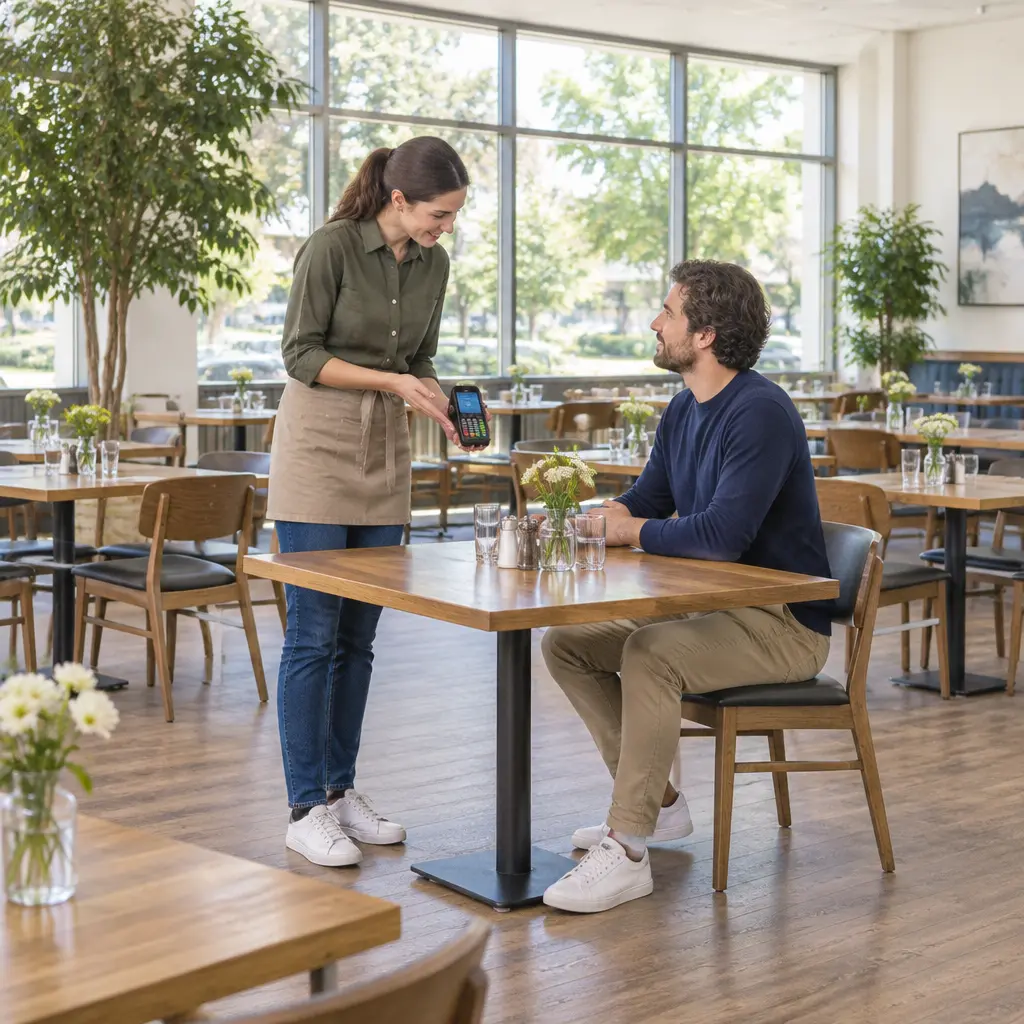
Payment friction is delay or confusion at checkout, including difficulty splitting a bill, uncertainty about tipping, or problems completing a transaction. Contactless payment, pay-at-table terminals, digital wallets, and clear digital receipts can address these issues. They should be implemented with visible staff support, straightforward options, and secure handling of payment data.
The Federal Reserve’s 2024 Diary of Consumer Payment Choice found that consumers made an average of 11 payments per month in cash in 2023, compared with 30 by credit card and 18 by debit card. The findings illustrate why card and digital-payment capability is important while also showing that cash remains part of the payment mix. A friction-first policy maintains workable alternatives rather than assuming every guest has a smartphone, bank card, or willingness to pay digitally.
Information and accessibility friction: help guests make informed choices
Information friction arises when guests cannot readily understand ingredients, allergens, prices, portion options, or service procedures. Accessibility friction occurs when a digital or physical process excludes people because of disability, language, device limitations, or unfamiliarity. Plain-language menus, legible type, accurate allergen guidance, keyboard-accessible ordering, and staff assistance can reduce both.
The U.S. Centers for Disease Control and Prevention estimates that about 1 in 10 adults in the United States has a food allergy. That makes accurate ingredient and allergen communication a practical safety concern, not a novelty feature. Digital information can be updated efficiently, but restaurants should establish ownership for keeping it accurate and train employees to handle questions that a menu cannot resolve. Technology should support—not replace—careful communication about cross-contact and preparation practices.
Operational Reliability as the Bridge Between Guest Benefits and Restaurant Technology Adoption
A smoother guest journey depends on what happens behind the scenes. Operational reliability connects front-of-house convenience to accurate menus, kitchen coordination, staffing, inventory, and timely service. A customer-facing tool that accepts orders but sends incomplete information to the kitchen can shift friction rather than eliminate it.
The National Restaurant Association’s 2024 technology research found that 76% of operators said technology gives their restaurant a competitive advantage. The figure reflects operators’ broad view of technology’s value; it is not proof that any individual system improves profit or guest satisfaction. Adoption should therefore be paired with workflow design, staff training, system integration, and performance measurement.
Kitchen and order management: prevent errors before adding features
Kitchen display systems, point-of-sale integrations, and order-management tools coordinate orders between guests, servers, and production teams. Their friction-reduction value depends on accurate modifiers, clear timing, and a usable process for handling substitutions or unavailable items. If channels produce duplicate tickets or obscure order priority, the technology can increase kitchen workload and lengthen waits.
Restaurants can validate these systems by tracking remakes, missing modifiers, ticket times, and order-status questions before and after implementation. They should also test peak periods, outages, and menu changes. A pilot in one location or service period can reveal integration problems before a wider rollout, while staff feedback can identify workarounds that headline performance metrics miss.
Reservations, waitlists, and service recovery: reduce uncertainty
Reservation and waitlist tools reduce uncertainty by communicating availability, estimated waits, and changes in status. Their usefulness depends on realistic estimates and clear escalation to a person when plans change. Automated messages can help guests plan, but misleading wait times or difficult cancellation steps can damage trust.
Service recovery is the process of responding when an order, reservation, payment, or service expectation fails. Digital systems can make it easier to identify a problem and record its resolution, but a guest still needs a clear route to human help. Restaurants should measure not only average wait time but also estimate accuracy, complaints, resolution time, and whether guests return after a problem.
Staff usability: prevent technology from transferring work
Staff usability is the degree to which employees can learn and use a system accurately during real service conditions. It is a core adoption requirement because cumbersome tools can increase training time, create workarounds, and reduce the attention employees can give guests. Interfaces should fit actual tasks, use consistent terminology, and provide clear procedures for errors and outages.
The U.S. Bureau of Labor Statistics reported that food preparation and serving occupations accounted for about 12.8 million jobs in May 2023. In a large, labor-intensive workforce, even small changes to training and task design can have significant operational consequences. Operators should include front-line employees in trials, protect time for training, and evaluate whether a system reduces repetitive work or simply adds another screen to monitor.
Technology Selection as a Measurable Restaurant Adoption Framework
A disciplined selection framework separates meaningful friction reduction from novelty. It starts with a specific guest or operational problem, establishes a baseline, tests an intervention, and checks for unintended effects. The restaurant should define success before purchasing, including the experience for guests who do not use the new channel.
Prioritize by impact, frequency, and inclusion
A practical prioritization score can combine how often a problem occurs, how strongly it affects guests, how many people it affects, and how feasible it is to solve. High-frequency problems such as confusing ordering or slow payment often deserve attention before rare, entertainment-oriented features. Safety, accessibility, and privacy concerns should act as safeguards, not optional points that can be outweighed by novelty.
-
Identify a journey problem using guest comments, observation, support requests, and staff input.
-
Estimate its frequency and impact, then identify which guest groups or service channels are affected.
-
Check accessibility, privacy, security, integration, and non-digital alternatives before selecting a tool.
-
Pilot the change in a limited setting and compare results with the baseline.
Measure outcomes rather than feature adoption alone
Feature adoption measures whether people use a tool; it does not establish that the tool made service better. Useful outcome measures include time to complete an order, checkout duration, order accuracy, abandonment, wait-estimate accuracy, complaint resolution, accessibility feedback, and staff-reported workload. Results should be segmented by channel and, where appropriate and responsibly collected, by relevant user needs so that an average improvement does not conceal a worse experience for some guests.
A simple evaluation table can clarify the decision:
-
Problem: Guests wait too long to close a check.
-
Intervention: Offer pay-at-table terminals while retaining staff-assisted checkout.
-
Measures: Checkout time, payment completion errors, guest comments, and employee workload.
-
Decision rule: Expand only if the change improves the target experience without increasing errors, excluding guests, or creating excessive staff burden.
Account for cost, privacy, security, and resilience
Total cost of ownership includes setup, subscriptions, payment fees, hardware replacement, integration, support, training, and the cost of downtime. A system that looks inexpensive at purchase may be costly if it requires extensive workarounds or locks essential customer information into an incompatible platform. Restaurants should review data collection, retention, vendor access, breach response, and applicable payment-security requirements before deployment.
Resilience matters because restaurants must continue serving guests when internet access, devices, or third-party platforms fail. A practical fallback may include an offline procedure, a printed menu, manual order entry, or a clear way for staff to process payments safely. These contingencies preserve service continuity and ensure the digital option remains an option rather than a single point of failure.
Restaurant Technology Adoption in Practice: A Guest-Journey Case
Consider a busy casual restaurant where guests report long waits to order and difficulty splitting checks. Rather than beginning with a novelty feature, the operator maps the journey, observes peak service, and finds two concrete obstacles: servers cannot reach every table quickly, and groups must wait for one employee to process separate payments.
The restaurant pilots optional table-side ordering for repeatable items and pay-at-table terminals, while keeping server ordering and cash payment available. It trains employees to answer questions, confirms menu modifiers reach the kitchen correctly, and monitors order errors, checkout time, guest feedback, and staff workload. If payment becomes faster but order confusion rises, the operator can revise the menu flow rather than declaring success based on transaction volume alone.
This example illustrates a transferable principle rather than a claim about a named restaurant: adoption succeeds when the tool addresses a documented problem, fits the operating model, and is evaluated against the full guest and employee experience. It also shows why technology decisions are ongoing. Menu changes, seasonal demand, new payment preferences, and staff turnover can alter whether a once-effective tool still reduces friction.
Conclusion: Make Restaurant Technology Serve the Guest Journey
Guest friction reduction provides a practical standard for restaurant technology adoption. Ordering, payment, information access, kitchen coordination, waitlist management, and service recovery are related parts of one journey, so improvements must work across both guest-facing and operational systems. Industry data shows that consumers use digital restaurant channels and operators see competitive value in technology, but those statistics do not justify novelty for its own sake.
Restaurants should start with a recurring, clearly defined problem; test an accessible solution; train the people who use it; and measure guest outcomes alongside staff workload, cost, security, and reliability. The broader implication is that effective restaurant innovation is not measured by how advanced a feature appears, but by whether it makes hospitality easier to deliver and easier to receive. Operators can begin by mapping one high-friction step in the guest journey and piloting a measurable improvement with a dependable non-digital fallback.
Sources: National Restaurant Association, 2024 State of the Restaurant Industry, https://restaurant.org/research-and-media/research/research-reports/state-of-the-restaurant-industry/; National Restaurant Association, Restaurant Technology Landscape Report, https://restaurant.org/research-and-media/research/; Federal Reserve, 2024 Findings from the Diary of Consumer Payment Choice, https://www.federalreserve.gov/consumerscommunities/shed_data.htm; U.S. Centers for Disease Control and Prevention, Food Allergies, https://www.cdc.gov/healthyschools/foodallergies/; U.S. Bureau of Labor Statistics, Occupational Employment and Wage Statistics, May 2023, https://www.bls.gov/oes/2023/may/oes_food-preparation-and-serving-related.htm.