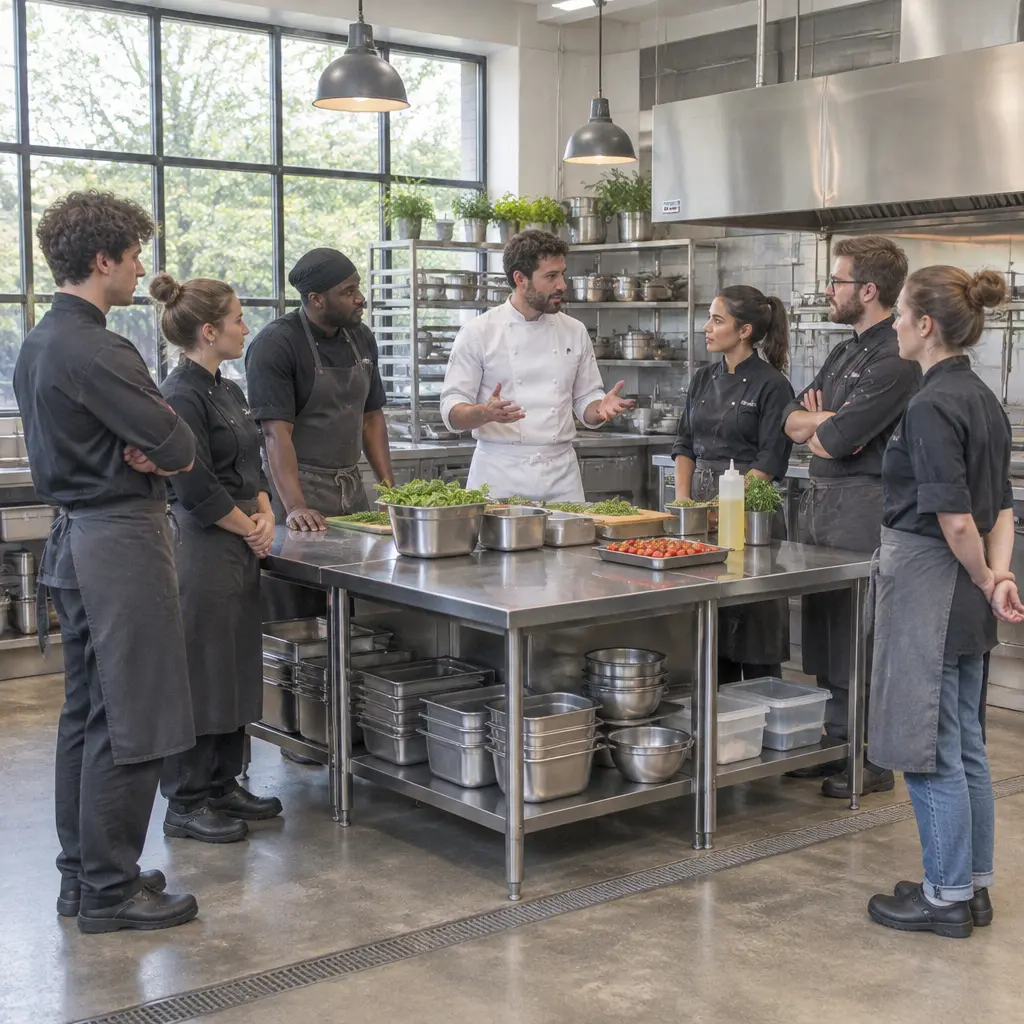
Chef leadership evolution is the shift from authority centered primarily on culinary control toward leadership that pairs a clear creative vision with conditions in which staff can speak up, learn, and work safely. Psychological safety—the shared belief that a team can take interpersonal risks without humiliation or retaliation—does not require lowering standards. It helps chefs surface mistakes, hazards, and ideas early, while structured coaching and fair accountability protect quality. This balance matters in an industry facing persistent staffing pressures: the U.S. Bureau of Labor Statistics projects about 2.6 million openings for food preparation and serving occupations each year, on average, from 2023 to 2033, largely because workers leave or change occupations. The sections below define the leadership pairing, explain its practical components, and show how kitchens can assess progress.
Chef Leadership Evolution: Creative Vision Paired With Psychological Safety
Chef leadership evolution describes how a chef’s role expands beyond designing menus and directing service to shaping the team’s working climate, communication, and development. Harvard Business School professor Amy Edmondson defines psychological safety as a shared belief that a team is safe for interpersonal risk-taking. In a kitchen, that means a cook can ask for clarification, flag a food-safety concern, admit an error, or propose an improvement without expecting ridicule or automatic punishment.
The pairing is important because restaurant work combines time pressure, interdependence, physical hazards, and exacting standards. A chef still needs to set expectations, make decisions, and protect the guest experience. The evolution lies in how those expectations are established: clear standards and direct feedback are combined with respectful questions, consistent procedures, and learning after mistakes. Psychological safety is not the absence of accountability; it is an environment where accountability can be fair, specific, and useful.
The National Restaurant Association’s 2024 State of the Restaurant Industry report described the sector as employing more than 15.5 million people and projected restaurant and foodservice sales of $1.1 trillion for 2024. These figures underscore the scale of the workforce and the operational stakes, but they do not establish that a particular leadership approach causes better retention or performance. Those outcomes depend on many factors, including pay, scheduling, workload, training, and local management.
How Creative Vision Shapes Chef Leadership Evolution
Creative vision is a chef’s articulated direction for the food and the experience: what the menu expresses, which ingredients and techniques matter, and how the team should deliver the concept. In leadership practice, vision works best when it is translated into shared principles and observable standards rather than left as an unspoken personal preference. The chef supplies direction; the team gains enough context to make sound decisions when the chef is not present.
Vision translated into clear standards
A standard is a repeatable expectation, such as a recipe specification, plating reference, temperature requirement, or service sequence. A chef can explain both the requirement and its purpose—for example, why a garnish is prepared to order or why a cooling procedure must be followed. This connection helps employees distinguish a non-negotiable safety rule from a creative choice that can be tested or refined.
The U.S. Food and Drug Administration’s Food Code provides a model framework for retail food safety, including temperature control, hygiene, and prevention of contamination. Local jurisdictions adopt and enforce their own requirements, so kitchens should follow applicable local rules rather than assume the model code is itself the governing law. A psychologically safe team should be able to stop and raise a credible safety concern even during a busy service.
Creative autonomy within guardrails
Creative autonomy is bounded discretion: staff can contribute ideas and make appropriate choices within agreed limits for safety, cost, consistency, and the restaurant’s identity. A chef might invite a station team to propose a seasonal special, then assess it against sourcing, prep capacity, allergen controls, and the concept. The process gives creativity a route into the menu without making every operational decision negotiable.
This approach also clarifies ownership. The chef remains responsible for the final direction, while employees can see how their knowledge influences decisions. When an idea is declined, a brief explanation—such as a supply constraint or conflict with the menu’s design—can preserve trust better than silence or personal dismissal.
How Psychological Safety Supports Chef Leadership Evolution
Psychological safety is a team climate, not a promise that every suggestion will be accepted or that mistakes have no consequences. Edmondson’s foundational 1999 study examined 51 work teams in a manufacturing company and found an association between psychological safety and learning behavior. The study helped establish the concept, but its setting was not restaurant kitchens, and it should not be treated as direct proof of a specific restaurant outcome.
For chefs, the practical implication is to make speaking up usable during real work. A team needs accessible ways to ask questions, report near misses, and discuss performance, along with a leader who responds without contempt or retaliation. Safety improves when leaders distinguish an honest, promptly reported error from deliberate disregard of a known procedure.
Speaking up about mistakes and hazards
Speaking up means communicating information that may be uncomfortable but matters to the team’s work. In a kitchen, examples include reporting a mislabeled allergen, a failing refrigerator, a cut, a missed handwashing step, or a ticket that cannot be completed safely at the promised pace. A chef who thanks the employee, contains the risk, and reviews the process signals that accurate reporting is valued.
The Occupational Safety and Health Administration identifies hazards such as cuts, burns, slips, and exposure to heat among risks relevant to restaurant work. Reporting alone cannot eliminate these hazards; appropriate equipment, training, staffing, maintenance, and safe procedures remain essential. Psychological safety supports those controls by making it less likely that warning signs stay hidden.
Respectful correction and fair accountability
Respectful correction addresses the work, the standard, and the next step without attacking a person’s worth. During service, feedback may need to be concise: identify the issue, state the required action, and confirm understanding. A fuller review can follow when the immediate pressure has passed. Consistency matters: applying rules selectively by rank, tenure, or personal preference weakens trust.
Accountability remains necessary where an employee knowingly ignores a safety rule, mistreats colleagues, or repeatedly fails to meet an explained standard. A fair process considers the facts, training, workload, and available resources, then applies proportionate consequences. That balance prevents “psychological safety” from becoming a rationale for avoiding difficult management decisions.
How Coaching and Communication Connect Vision With Safety
Coaching connects the chef’s direction to employees’ developing judgment. Rather than only issuing orders, a coaching-oriented chef demonstrates techniques, asks what the employee noticed, and gives a clear next step. The aim is not to replace decisive leadership during a rush but to build competence outside the most time-sensitive moments.
Structured feedback and skill development
Structured feedback is specific, timely, and linked to an agreed standard. For example: “The sauce separated because the pan was too hot; lower the heat and whisk in the liquid gradually.” This is more useful than a personal label such as “careless.” Chefs can pair correction with demonstration and a chance to retry, while recognizing reliable work so employees understand what to repeat.
Training should be planned rather than assumed. The National Restaurant Association’s ServSafe program offers food-safety education and certification options, while employers remain responsible for ensuring that instruction matches job duties and applicable local requirements. A certificate cannot substitute for supervised practice, accessible procedures, or a workplace where staff can ask questions.
Pre-shift briefings and post-service learning
A pre-shift briefing aligns the team on menu changes, reservations, station responsibilities, allergens, shortages, and expected service conditions. It can also establish a simple escalation route: whom to alert, what information to share, and what decisions staff are authorized to make. Briefings are most effective when they are short, consistent, and open to clarifying questions.
A post-service review turns experience into learning. The team can identify one success, one friction point, and one action for the next shift. The review should focus on observable events and workable improvements rather than public blame. For recurring problems, managers can examine root causes such as unclear prep lists, equipment failures, unrealistic ticket timing, or insufficient training.
How to Assess Chef Leadership Evolution in Practice
Assessment combines employee feedback with operational indicators. No single metric proves psychological safety: a low incident count, for example, may reflect effective prevention or underreporting. Chefs should interpret measures in context and use them to ask better questions, not to pressure staff into producing favorable numbers.
Employee voice and climate checks
A brief anonymous pulse survey can ask whether employees feel able to request help, report a mistake, question an unsafe instruction, and offer ideas without being embarrassed. Pairing those questions with short listening sessions can reveal where station hierarchy or shift patterns affect access to the chef. Leaders should explain what they will do with the responses and report back on resulting changes.
A useful practice is to track whether concerns receive acknowledgment and follow-up, not merely how many are submitted. If reports rise after a new reporting channel is introduced, that may indicate improved visibility rather than worsening conditions. Interpretation should include worker experience and the nature of the reports.
Operational indicators and limits
Relevant indicators may include turnover, absenteeism, training completion, near-miss reporting, injury patterns, food-safety deviations, rework, and service consistency. The Bureau of Labor Statistics’ projection of roughly 2.6 million annual openings across food preparation and serving occupations from 2023 to 2033 reflects the size and movement of the broader workforce; it is not a restaurant-specific turnover rate and does not measure the effect of chef leadership.
Managers should establish a baseline, review trends over time, and account for changes in seasonality, staffing, menu complexity, and business volume. A chart can help teams compare monthly turnover, training completion, and reported near misses, but it should show definitions and time periods clearly. Metrics should guide inquiry and improvement, not be used as a reason to punish workers for reporting problems.
Conclusion: Sustaining Creative Vision and Staff Psychological Safety
Chef leadership evolution brings creative vision, clear standards, bounded autonomy, psychological safety, coaching, and fair accountability into one operating approach. Vision gives a kitchen direction; psychological safety helps staff communicate the information needed to deliver that direction safely and consistently. Research on team learning supports the importance of psychological safety as a workplace concept, while restaurant-specific results should be assessed locally rather than assumed.
Chefs and restaurant managers can begin with practical steps: clarify non-negotiable safety standards, invite questions in pre-shift briefings, respond constructively to reported hazards, give specific feedback, and review employee and operational indicators together. Further reading from Amy Edmondson, the FDA Food Code, OSHA, the Bureau of Labor Statistics, and the National Restaurant Association can help leaders connect team practices with evidence and regulatory context.
Sources: Amy C. Edmondson, “Psychological Safety and Learning Behavior in Work Teams,” Administrative Science Quarterly, 1999, https://doi.org/10.2307/2666999; National Restaurant Association, 2024 State of the Restaurant Industry Report, https://restaurant.org/research-and-media/research/research-reports/state-of-the-restaurant-industry/; U.S. Bureau of Labor Statistics, Occupational Outlook Handbook: Food and Beverage Serving and Related Workers, https://www.bls.gov/ooh/food-preparation-and-serving/food-and-beverage-serving-and-related-workers.htm; U.S. Food and Drug Administration, Food Code 2022, https://www.fda.gov/food/fda-food-code/food-code-2022; Occupational Safety and Health Administration, Young Workers: Restaurant Safety, https://www.osha.gov/young-workers/restaurant-safety; National Restaurant Association, ServSafe, https://www.servsafe.com/